The guide · Yoga and wellness · 5 min read
Breathwork for beginners, a simple, careful start
Breathwork for beginners, with three gentle ways to start, what research says, why the fast styles need care, and who should ask a doctor first.

Breathwork means breathing in a chosen way for a few minutes, on purpose. A beginner should start with the slow, gentle kinds, which are low in risk for healthy people, and leave the fast, forceful kinds to a session with a trained teacher.
What is breathwork?
You breathe all day without thinking. Breathwork is the few minutes when you do think about it. You make the breath slower, or deeper, or you give it a count.
There are two families. The slow family calms: belly breathing, counted breathing, long breaths out. The fast family stirs you up on purpose, with quick, strong breathing and sometimes holding the breath. They are different things, and most of the care in this article is about the second.
Three gentle ways to begin
Sit or lie down somewhere quiet. Five minutes is enough.
- Belly breathing. Put one hand on your chest and one below your ribs. Breathe in slowly through the nose so that the lower hand rises and the upper one stays almost still. Breathe out slowly and feel the belly fall. Britain's health service suggests counting to five on the way in and five on the way out, for at least five minutes.
- Box breathing. Breathe in for four, hold for four, breathe out for four, hold for four. Three or four rounds. If the holds feel tight, make the count shorter.
- The long breath out. Breathe in through the nose, then take a second, short sip of air on top to fill the lungs. Then let it all go slowly through the mouth, longer than the breath in. Repeat for five minutes.
None of these should make you dizzy. If one does, stop and breathe normally. If you live with asthma, another lung condition or anxiety, the Cleveland Clinic advises asking your doctor before you practise even belly breathing.
What does research say?
It says something modest and honest.
In a study published in 2023, 108 people practised for five minutes a day for a month. Some did the long breath out, some did box breathing, some did a faster style, and some did mindfulness meditation. Day by day, the breathing groups reported a bigger lift in good mood than the meditation group, and the long breath out did most. Anxiety went down in every group, about equally. The groups were small, and people reported their own practice and their own mood.
In the same year a review put together 12 controlled trials with 785 adults. Breathwork lowered stress a little to moderately compared with doing nothing special. The reviewers added that many of the studies had weaknesses, and they warned that the excitement around breathwork has run ahead of the evidence.
So a few slow minutes a day may help you feel calmer. It is a habit, not a medicine, and it does not replace care from a doctor.
Why do the fast styles need care?
Quick, strong breathing blows off carbon dioxide faster than the body makes it. Medical sources describe what follows: lightheadedness, tingling in the hands and around the mouth, cramps in the hands and feet, a pounding heart. Some people faint.
Two rules come from that.
- Never in or near water. Not in the sea, not in a pool, not in a bath. Health authorities warn that over-breathing before going underwater, or long breath holds, can make a person black out and drown. Not while driving either.
- Only with a trained teacher, lying or sitting down, in a place where somebody is watching the room.
Strong sessions can also bring up strong feelings. That is known, and it is one more reason to do them with somebody experienced.
Who should check with a doctor first?
For the slow kinds, most healthy people need no permission. The United States health agency NCCIH describes relaxation techniques as low in risk for healthy people. It adds that a few people feel more anxious during them, and that there are rare reports of symptoms getting worse in people with epilepsy, certain psychiatric conditions, or a history of trauma.
For the fast kinds, medical sources are much firmer. Speak to your doctor first, and many say do not take part at all, if any of these is true for you:
- A heart condition, or high or low blood pressure
- Epilepsy or a history of seizures
- A history of stroke
- Asthma or another lung condition
- Panic attacks, psychosis or another serious mental health condition
- A recent injury or operation
- You take regular medicine
- You are pregnant or breastfeeding
Tell the teacher too. A good one will ask before you do. This is general information, not medical advice.
When do we offer breathwork?
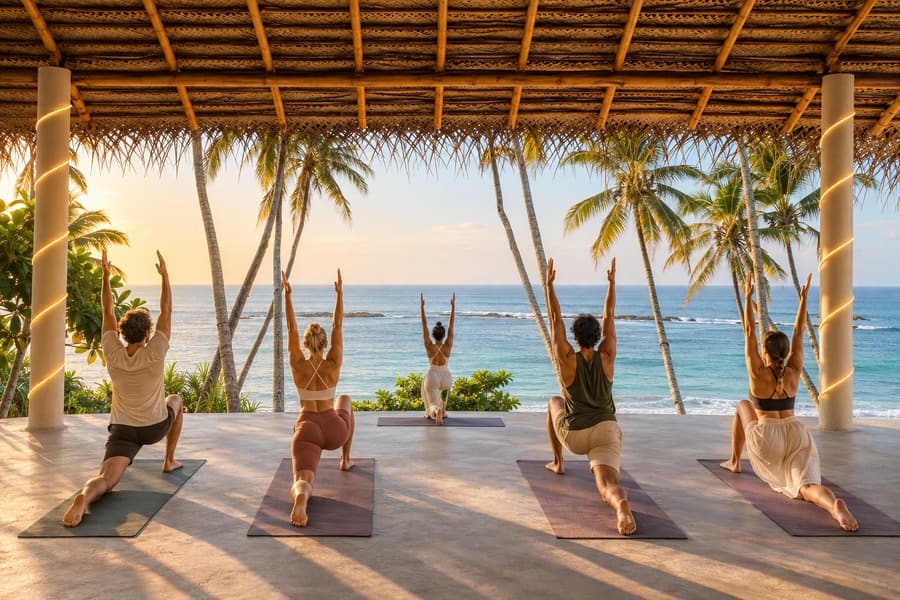
Breathwork is one of the sessions we hold at times in our oceanfront shala, beside the regular yoga classes, and Kristina leads it. We are setting up the shala's week anew, so the next session is on our events page.
Until then, every yoga class is also a breathing class. In vinyasa the breath leads each movement, and in yin there is nothing to do but breathe. Our classes are described in yoga in Dikwella, and the styles in vinyasa, hatha or yin. The week's schedule starts from the page of our yoga and wellness shala in Dikwella.
And the three gentle ways above need no class at all. A hammock under the palms will do.
Good to know
- Regular classes in the shala cost 4,000 LKR. People who live in Sri Lanka, locals and expats, and our regulars join for 3,000 LKR.
- The shala's week is being set up anew, so look at the events page before you come.
- Join any activity and you get 10% off the whole restaurant menu.
- Filtered water is on the house.
- We are at Turtle Beach, Dikwella, less than five minutes by road from Hiriketiya.