The guide · Yoga and wellness · 5 min read
Cacao ceremony and women's circle explained
What a cacao ceremony and a women's circle are, where they come from, what to expect, who should take care, and our Women's Circle and Cacao.
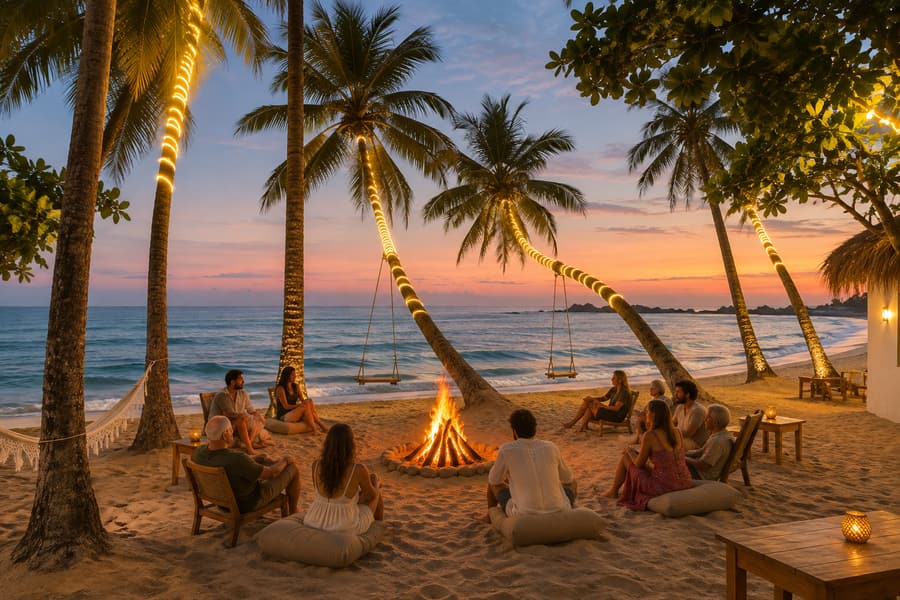
A cacao ceremony is a quiet gathering in which people drink a cup of pure, thick cacao together and take time to reflect. A women's circle is a group of women who sit in a ring, speak one at a time and listen to each other, and the two are often held as one evening.
What is a cacao ceremony?
The cup is the centre. It holds cacao in its simplest form: whole beans, fermented, roasted and ground into a paste, melted into hot water. It is not cocoa powder and it is not a chocolate bar. The fat of the bean is still in it, so the drink is thick, dark and bitter, sometimes with a little spice or something sweet.
Around the cup there is a simple order. People sit down together. Each one thinks of an intention, a word for what they hope the evening holds. The cacao is drunk slowly. Then there may be silence, a guided meditation, music, some gentle movement, or time to speak.
It is not a religious service, and nobody has to believe anything.
Where does cacao come from?
Cacao comes from the Americas, and people have used it for a very long time. The oldest traces known so far are in the upper Amazon, in what is now south-east Ecuador, from more than five thousand years ago. Later it travelled north to Mesoamerica.
Among the Maya, cacao was part of ceremonies, feasts, weddings and offerings, and the beans were used as money. It was poured from a height to raise a foam. Among the Aztecs, later, it was mostly a drink of the powerful, offered to rulers and to gods, and often mixed with ground chilli. Sweetening it with sugar began with the Spanish.
So cacao is truly an old and honoured plant, and its home is with the peoples of Central and South America.
Is the cacao ceremony ancient?
The plant is. The gathering you find in yoga places around the world today is not.
The modern cacao circle, with its seated ring, its intentions and its sharing, is recent. Most accounts trace it to small gatherings around Lake Atitlán in Guatemala in the early 2000s, from where it spread through the yoga world. Maya communities have their own living ways with cacao, and those are theirs. A wellness evening with a cup of cacao is something else: a new custom that borrows an old plant.
Some writers criticise evenings that are sold as an "ancient Mayan ceremony". We think the honest way is simple. Say thank you to where the plant comes from, and do not pretend to hold a rite that belongs to somebody else.
What is a women's circle?
Women have always sat together. The circle as a named practice is modern. People who study it point to the women's groups of the 1960s and 1970s, where women met to talk honestly about their lives, to Anita Diamant's novel The Red Tent of 1997, which moved many readers to open their homes for monthly gatherings, and to the books of the psychiatrist Jean Shinoda Bolen.
The form is plain:
- Everybody sits in a ring, so nobody is at the front.
- One person speaks at a time. Often an object is passed from hand to hand, and whoever holds it speaks.
- The others listen. No advice, no fixing, no interrupting.
- What is said stays in the circle.
- Silence is allowed. You may pass.
Researchers have listened to women who attend circles, and many describe feeling connected and heard. Those are interviews and not measurements. We know of no controlled study, so we make no promise about what a circle does. For most people it is a rare thing: an hour of being listened to.
Who should take care with cacao?
Cacao holds theobromine, a mild stimulant, and some caffeine. A ceremonial cup is far stronger than a hot chocolate, and people who are sensitive to caffeine may notice it.
Ask your doctor first, and tell the person who leads the circle, if you are pregnant or breastfeeding, if you have a heart condition, if you take antidepressants or any regular medicine, or if caffeine does not agree with you. The advice you will hear about doses comes mostly from the people who sell cacao and not from doctors, so your own doctor is the one to ask.
In most circles you can ask for a smaller cup, or sit in the ring without drinking. This is general information, not medical advice.
What is our Women's Circle and Cacao?
It is one of the specials of our shala, held by Kristina, and it costs 6,000 LKR. Women sit together in a circle, each with a cup of cacao, at Turtle Beach with the ocean beside them. We are setting up the shala's week anew, so the next circle is announced on our events page.
Come as you are. You do not need to have done anything like it before, and you do not need to speak.
If you would like something that is open to everybody, the Bonfire Circle is every Sunday at 6 PM, on the sand, and it is free. For the classes that fill the other days, see yoga in Dikwella, and for quiet rest with sound, sound healing explained. The week's schedule starts from the page of our oceanfront shala for yoga and wellness in Dikwella, and workshops and circles are on events.
Good to know
- Women's Circle and Cacao is a special, 6,000 LKR. The next date is on the events page.
- The Sunday Bonfire Circle is at 6 PM and free.
- Join any activity and you get 10% off the whole restaurant menu.
- No alcohol is served at Ohana. Filtered water is on the house.
- We are at Turtle Beach, Dikwella, less than five minutes by road from Hiriketiya.