The guide · Yoga and wellness · 5 min read
Digital detox on Sri Lanka's south coast
Why people come to Sri Lanka's south coast to switch off, what research says about putting the phone down, small steps that work, and places that help.
People come to the south coast of Sri Lanka to switch off because the days here are simple: sea, shade, food, an early night. You do not need to lock your phone away to feel the difference. A few small rules and the right kind of place do most of it.
Why do people come here to switch off?
Because the coast makes it easy. The sun comes up at about six and goes down at about six. The sea is warm. Between Dikwella and Tangalle the bays are small and the evenings are quiet. There is little that must be done and nothing that must be queued for.
At home, the phone fills every gap. Here the gaps fill with other things: a turtle's head coming up for air, a fishing boat, a dog asleep in the shade. Nobody plans that. It simply happens when the phone stays in the bag for an hour.
What does research say about putting the phone down?
It says the effect is real for some people, and smaller and more mixed than the headlines.
- One careful experiment, published in 2025, asked 467 people to block the internet on their phones for two weeks. Calls and texts still worked, and so did their computers. On average their attention, their mental health and their sense of wellbeing improved. Only about a quarter of them managed to keep the block on for most of the two weeks, which says something too.
- A review of 21 studies of breaks from phones and social media found mixed results. Some people felt better, some felt no change, and a few felt worse.
- Time outdoors seems to matter. In a survey of nearly 20,000 adults in England, those who had spent two hours or more in nature in the past week were more likely to report good health and wellbeing. It made no difference whether it was one long visit or several short ones. That is a link, not proof of a cause.
- Evenings. Harvard's medical school notes that light at night, and blue light from screens most of all, holds back melatonin, the hormone that tells the body it is night. It suggests staying away from bright screens for two to three hours before bed.
So the honest promise is a small one. Less phone and more sea will probably feel good. It will not change your life in a week, and it is not a treatment for anything.
Which small steps work?
Small ones work better than heroic ones. Choose two or three.
- Keep the first hour. No phone until after breakfast. Walk, swim or sit instead.
- Put it in the bag, not on the table. Out of sight is easier than face down.
- Choose one time to look. For example at five in the afternoon, for twenty minutes. Tell the people at home that you will answer then.
- Turn off the internet, keep the phone. Flight mode still leaves you a camera, a map you downloaded and a book.
- Carry paper. A novel, a notebook, a pack of cards.
- Take the photograph, post it next week. The sunset does not need an audience tonight.
- Stop when the sun goes. Dinner without screens, and sleep comes early here anyway.
If you have to work some days, that is fine. Work in one block, close the laptop, and let the rest of the day be free. We have Wi-Fi and sockets for exactly that, and our page about working by the sea explains how.
Which places and habits on this coast help?
- A sunrise walk. Dikwella's long beach is nearly empty early in the morning.
- A swim with a mask. You cannot hold a phone under water. In our bay, wild sea turtles often feed on the reef, and we lend masks free. Never touch, chase or feed them.
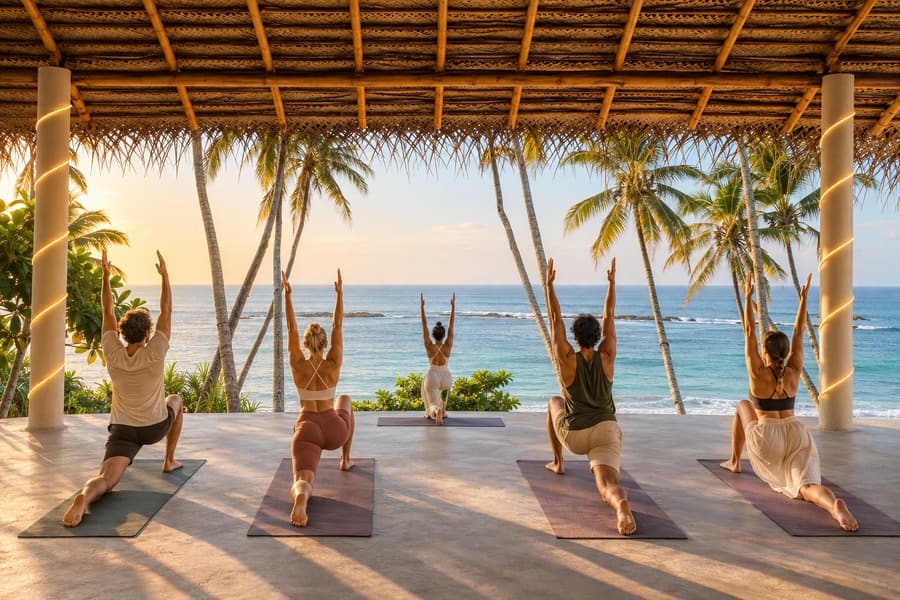
- A class. For an hour somebody else decides what happens next, and the phone is in a bag at the edge of the room.
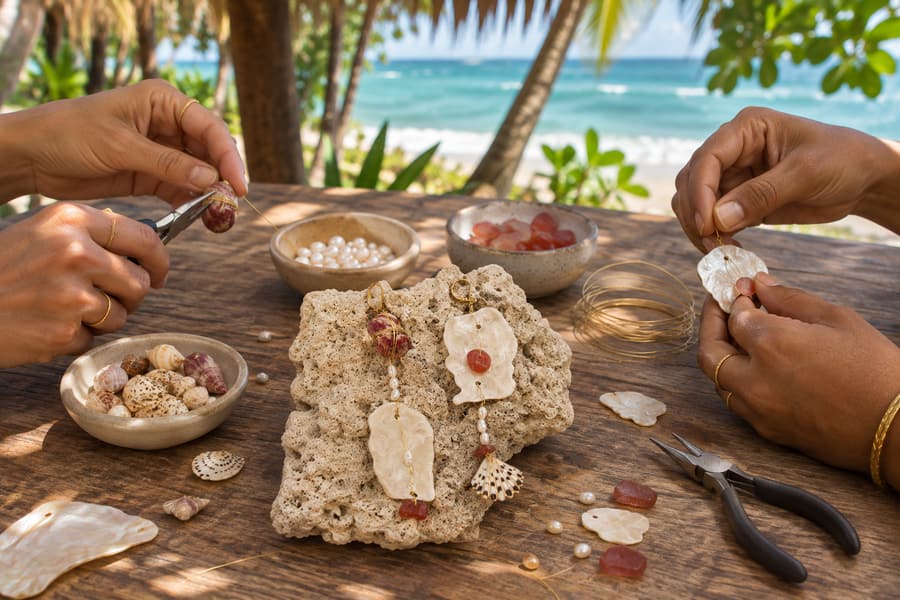
- Something for the hands. A workshop where you make a piece of jewellery or a painting holds the attention in a way a screen does not. We wrote about it in mindful painting and making with your hands.
- A fire. On Sunday at 6 PM we light the Bonfire Circle on the sand. Feet in the sand, a moment to look back at the week. It is free.
- A long table. A whole fish to share takes time to cook and time to eat. That is the point of it.
- One outing inland. The rock temple at Mulkirigala, about forty minutes away, has around 500 steps. That is one more hour without a screen.
It also helps to choose a place without loud music and without a party. We serve no alcohol, and our evenings stay calm.
What would such a day look like with us?
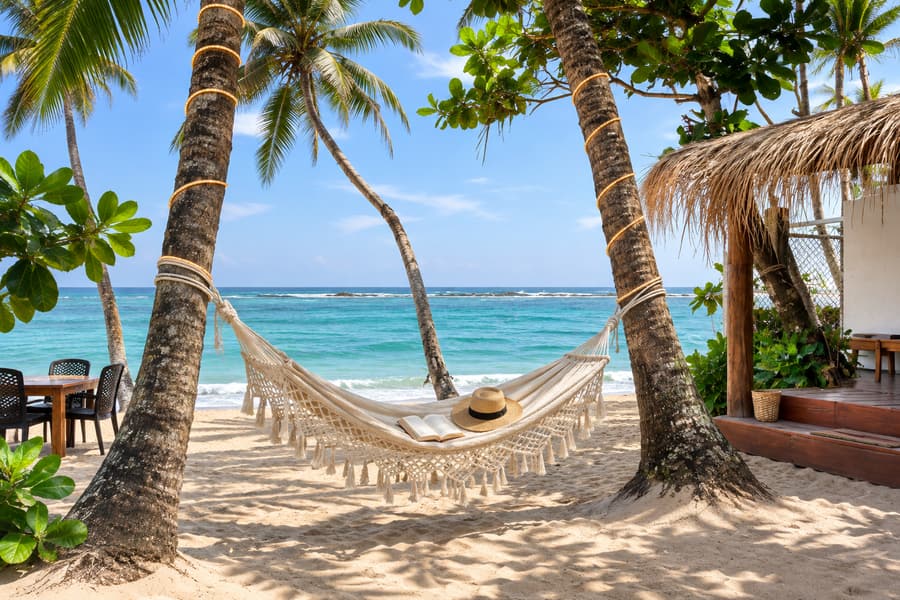
Arrive for a morning class in the shala. Swim. Eat breakfast slowly, before 11:00. Take a sunbed or a hammock in the shade with a book, and sleep if sleep comes. Have lunch late. Walk the edge of the water when the sun is lower. Watch it go down with a mocktail or a pot of tea. Eat early, and go home ready for bed.
We will not take your phone away, and the Wi-Fi stays on. We only notice that people look at the sea more than at their hands here. A fuller version of this day is in a wellness day by the sea, and the classes and circles of the week start from the page of our shala for yoga and wellness in Dikwella.
Good to know
- We are at Turtle Beach, Dikwella, less than five minutes by road from Hiriketiya.
- Breakfast is served from 08:00 to 11:00, lunch and dinner from 11:00 to 21:00, every day.
- Sunbeds are free for the whole day, one for each person, when each person spends 10,000 LKR on food and drinks; otherwise they cost 1,000 LKR an hour each. A towel comes with every sunbed.
- The Sunday Bonfire Circle is at 6 PM and free.
- No alcohol is served. Filtered water is on the house.