The guide · Seafood and where to eat · 5 min read
Eating with allergies in Sri Lanka, an honest guide
Where fish, nuts, wheat and other allergens hide in Sri Lankan cooking, how to ask, what to carry, and what our own menu can and cannot promise you.
You can travel and eat in Sri Lanka with a food allergy, but you have to ask more than at home, because the cooking hides fish, nuts and wheat in places a visitor does not expect. At Ohana every dish lists its allergens and all its ingredients, and we tell you plainly that ours is one shared kitchen where traces cannot be excluded.
This is practical advice from a restaurant, not medical advice. Your doctor knows your allergy. Speak to them before you travel.
Where do allergens hide in Sri Lankan cooking?
The island's food is generous and layered, and that is exactly the difficulty. These are the ones to know.
- Fish, in vegetable dishes. Dried, cured tuna called Maldive fish is used in small amounts in many vegetable curries and in pol sambol, the coconut relish on almost every table. A dish with no fish in its name can still hold fish.
- Coconut, everywhere. Coconut milk and grated coconut are in nearly every kitchen, every day.
- Cashews and peanuts. There is a curry made of whole cashews, and nuts go into sweets and snacks. Peanut sauces come with some grilled dishes.
- Sesame. In sweets, and as an oil.
- Wheat. In godamba roti and in kottu, which is chopped roti. String hoppers are made from rice meal or from wheat flour, and you cannot tell by looking.
- Egg and milk. Egg hoppers, the steamed pudding called watalappam, buffalo curd.
- Shellfish. Prawns, crab and cuttlefish are everyday food on the coast.
- Mustard and soy. Curry powders can hold mustard: the one in our own fish taco does. Soy sauce is in many sauces of Asian style.
One more thing makes it harder than at home. In small kitchens many dishes are cooked from memory, not from a written recipe, so the answer you get depends on the person you ask.
How do you ask?
- Tell them before you order, every time. People can only look after you if they know.
- Ask what is in the dish, not whether it is "fine". "Is there dried fish in this?" gets a truer answer than "Is this vegetarian?"
- Carry it in writing. A short note in Sinhala and in Tamil that names what you cannot eat, and says that a small amount is enough to make you ill. Your hotel can write it for you in two minutes.
- Learn three words. Malu is fish. Biththara is egg. Kiri is milk. "Mama malu kanne naa" means "I do not eat fish".
- Choose kitchens that cook to order and can show you the ingredients. A buffet cannot tell you what touched what.
- If the answer is unsure, do not eat it. Order the grilled fish, the plain rice, the fruit.
What should you carry?
Allergy organisations give the same advice for every country:
- Your medicine, in your hand luggage and then in your day bag. If you have been prescribed adrenaline auto-injectors, carry two doses with you at all times, not in the hotel room.
- A companion who knows. Somebody travelling with you should know where the medicine is and how to use it.
- Your plan on paper. What to do, and whom to call.
- The nearest hospital, looked up before you need it. Ask your hotel on the first day. From Ohana, the nearest hospital is about five minutes away: ask us and we point the way.
A severe reaction is an emergency. Adrenaline first, then a hospital, even if the person feels better.
What does our menu tell you?
More than most, and we would like you to use it.
- Allergens on every dish. The full menu lists them for each plate and each drink: gluten, crustaceans, molluscs, fish, eggs, milk, soy, peanuts, nuts, sesame, mustard, celery and sulphites.
- Every ingredient, by name. Sauces are opened up into what is in them. Our Tiradito Sauce shows its soy sauce. Our mayonnaise shows its egg and mustard.
- Three plain marks. "No gluten ingredients", "no dairy ingredients" and "no nut ingredients" mean exactly that: none in the recipe.
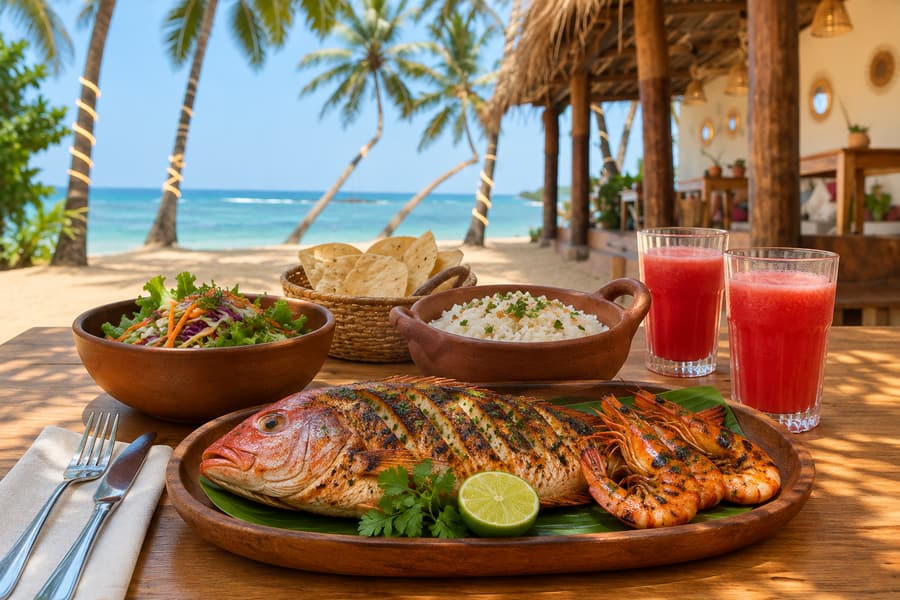
A few examples. The Sweet Prawn Curry, 6,700 LKR, lists crustaceans and nothing else. The Mahi Mahi Pineapple Curry, 6,900 LKR, lists fish and sulphites. Coconut Mashed Potatoes, 1,500 LKR, and Steamed Basmati Rice, 800 LKR, list none. The Grilled Catch of the Day, 7,900 LKR, lists fish and sulphites, and also milk and soy, because the snapper is basted with a margarine butter that contains both. The Milk Rice, 1,850 LKR, is served with toasted nuts and lists peanuts and nuts.
What can we not promise?
That a plate is free of traces. We say it on the menu and we say it here.
- One kitchen. Everything is prepared in the same space, including the flour for our sourdough. A dish with no gluten in its recipe is not a dish made in a gluten-free kitchen.
- One fryer. Fries, plantain chips and papadam are fried in the same oil as our fish, prawns and floured calamari, so they may carry traces of gluten, fish, crustaceans and molluscs. The menu marks each of these dishes. Tell us before you order: where the dish allows it, we cook yours in a clean pan with fresh oil.
- If your allergy is serious, choose a dish that does not list it, and tell us all the same.
We will advise you honestly, and that sometimes means saying "not this one". We would rather lose an order.
To read more about what is in the island's bowls, see Sri Lankan curry explained. If your worry is chilli, not allergy, there is not spicy food in Sri Lanka. How our kitchen works is on the page of our seafood restaurant in Dikwella, near Hiriketiya.
Good to know
- Every dish at Ohana lists its allergens. Ours is one shared kitchen with one fryer, so traces cannot be excluded.
- Tell us about any allergy before you order. Food is not spicy unless the dish says so.
- Breakfast is served from 08:00 to 11:00, lunch and dinner from 11:00 to 21:00, every day.
- Prices are in LKR, plus a 10% service charge. Filtered water is on the house.
- We are at Turtle Beach, Dikwella, less than five minutes by road from Hiriketiya.