The guide · Getting here and around · 5 min read
Whale watching from Dikwella, a day trip to Mirissa
How to go whale watching from Dikwella or Hiriketiya, with where the boats leave, the season, how to choose a responsible boat and how to plan the day.
The whale watching boats of the south coast leave from Mirissa harbour, about 33 km west of Dikwella, early in the morning. The season runs from about November to April, and with an early start you are back in Dikwella in time for a late lunch.
Where do the boats leave from, and how far is it?
From the fishing harbour at Mirissa. There is no whale watching from Dikwella or Hiriketiya themselves.
By road Mirissa is about 32 to 34 km from Dikwella, through Matara. Allow 45 minutes to an hour, less before dawn when the road is empty. Most boats leave between 6:00 and 7:00, and operators ask you to be at the harbour around 6:15 or 6:30. So you leave Dikwella at about 5:15.
Book a car or a tuk-tuk the evening before, and agree that the driver waits or comes back for you.
When is the season?
From about November to April, when the sea on this coast is calmer. Most guides name the middle of the season, around January to March, as the best months. During the south-west monsoon, from about May, the water is too rough and most boats stay in the harbour.
Even in season, a trip can be cancelled for weather. The rules for whale watching boats say they must not go out in bad weather, and a good operator will tell you so the evening before.
What might you see?
- Blue whales. The reason people come. The deep water south of Mirissa is one of the places in the world where the largest animal on earth is seen from day boats.
- Other whales. Sperm whales and Bryde's whales are also reported.
- Spinner dolphins. Often in large groups, and often the liveliest part of the morning.
What you see of a whale is usually a blow, a long grey-blue back, and sometimes the tail as it dives. Nobody can promise even that. These are wild animals in open ocean. An operator who guarantees a whale is promising something that is not theirs to give.
How do you choose a responsible boat?
This matters, because whale watching here has a problem. Journalists and conservation groups have written for years about too many boats crowding one whale, and about boats chasing whales from behind. Constant pressure of this kind can drive whales away from the places where they feed.
Sri Lanka has rules. The Sea Mammals (Observation, Regulation and Control) Regulations of 2012, made under the Fauna and Flora Protection Ordinance, say among other things:
- every boat needs a licence from the Department of Wildlife Conservation
- a trained, registered guide must be on board
- the boat slows down from 400 metres, switches off its engine at 100 metres from a whale, and never goes closer than 100 metres
- it keeps 50 metres from dolphins and other sea mammals
- it does not sail in front of or behind the animals, and does not change speed or direction suddenly
- nothing is used to attract the animals, and no food goes into the sea
- passengers do not get into the water
- the boat carries life jackets for everybody
You can read the regulations as published in the government Gazette. They were amended in 2019, so check the current rules before you travel.
When you book, ask plain questions. Conservation groups suggest these:
- "Are you licensed, and is there a trained guide on board?"
- "How close do you go to a whale?" The right answer is 100 metres or more.
- "What do you do when other boats are already around a whale?" The right answer is that they look for another animal, or wait their turn at a distance.
- "Can we swim with the whales?" The right answer is no.
- "Do you guarantee a sighting?" A careful answer is better than a confident one.
Smaller groups, a calm briefing before leaving, and a crew that talks about the animals and not only about photographs are good signs. On the boat, you help too: do not ask the captain to go closer.
How does the day fit together?
- About 5:15. Leave Dikwella or Hiriketiya.
- About 6:15 to 6:30. At the harbour. Boats leave by about 7:00.
- The trip. Usually three to five hours. Some go on longer when the whales are far out, so do not plan anything tight for midday.
- Late morning to early afternoon. Back in the harbour.
- The way home. About an hour, or more if you stop. Matara's Star Fort and the lighthouse at Dondra are on the way. Both are in our list of places to see near Dikwella.
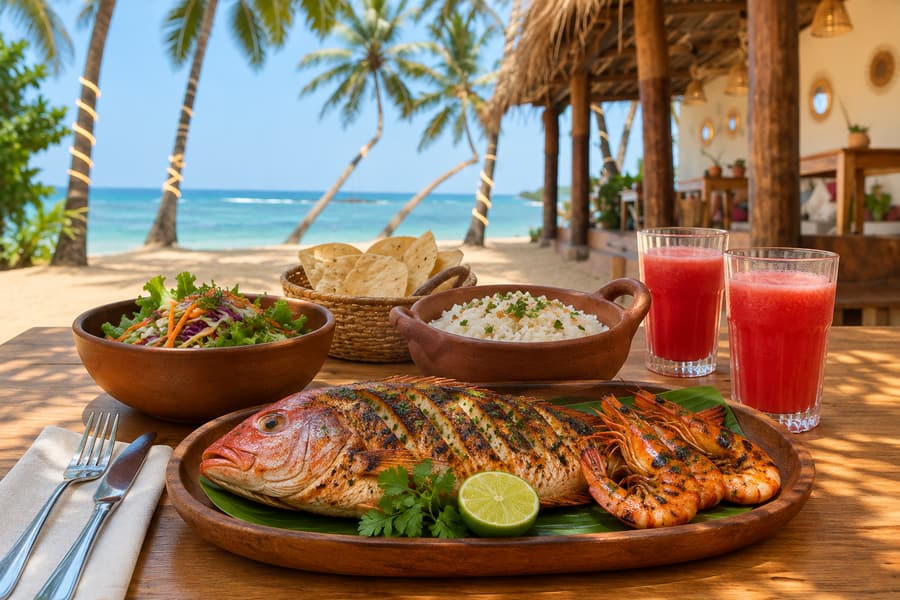
Our kitchen serves lunch from 11:00 to 21:00 without a break, so it does not matter if the boat is late. After a morning on the open sea, a table by a calm bay and something from the grill feels earned. The Grilled Catch of the Day is a whole snapper cooked on the bone (7,900 LKR), and the Tuna Poke Bowl (4,500 LKR) is the lighter choice.
What should you bring?
- Something for seasickness, if you are prone to it. The boats go far out and the swell is long. Ask a pharmacist the day before what suits you, and eat lightly before you board.
- A hat that ties on, sunglasses and sun protection. You are out in the open for hours, and the sea throws the light back at you.
- A light jacket. It can be cool at dawn on the water.
- Water, and a dry bag for your phone.
Small children and people with back trouble may find a long morning on a rolling boat hard. Think about it honestly before you book.
There is more to do on quiet days in our Dikwella and Hiriketiya travel guide, and in things to do in Dikwella.
Good to know
- Ohana is at Turtle Beach, Dikwella, less than five minutes by road from Hiriketiya.
- Lunch and dinner are served from 11:00 to 21:00, every day. Breakfast is from 08:00 to 11:00.
- Prices are in LKR, plus a 10% service charge. Filtered water is on the house.
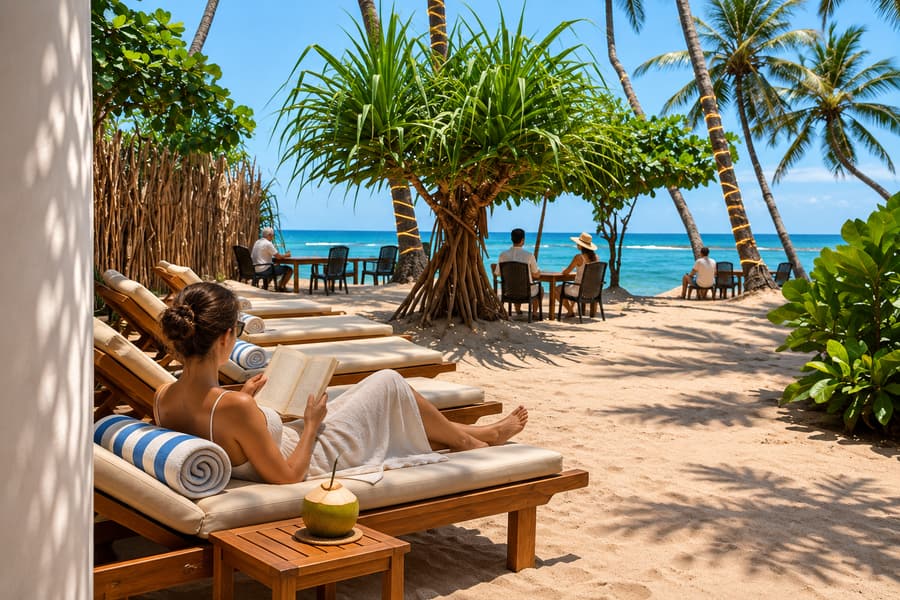
- Sunbeds are free for the whole day, one for each person, when each person spends 10,000 LKR on food and drinks; otherwise they cost 1,000 LKR an hour each. A towel comes with every sunbed.
- Wild sea turtles often feed on the reef of our bay, so the day can end with one more animal. Masks are lent free.