The guide · Beaches and slow days · 5 min read
Sri Lanka's south coast for older travellers
An honest guide to Sri Lanka's south coast for older travellers, with the heat, the steps and the sand, quiet places, an easy pace and gentle food.
The south coast of Sri Lanka suits older travellers well when the day is planned around the heat: an early start, shade through the middle hours, short drives and one outing a day. The towns between Galle and Tangalle lie close together, so the pace is yours to set.
What is the heat really like?
It is warm all year, and it hardly changes. On this coast the days reach about 29 to 30 degrees and the nights stay near 24 or 25. The air is humid, and the sun stands high from late morning until mid-afternoon.
You know your own body better than any guide. What follows is general advice from public health sources, not medical advice.
- Use the morning. Walk, visit and swim before about ten. Come out again after four.
- Sit in the shade at midday. The World Health Organization notes that shade can feel more than ten degrees cooler than direct sun.
- Drink before you are thirsty. The same source suggests about a cup of water an hour in hot weather.
- Dress light and loose, with a hat that has a brim.
- Ask your doctor before you travel how your regular medicines and the heat go together. It is a short conversation and a useful one.
At Ohana, filtered water is on the house all day. Ask as often as you like.
How hard is it to get around?
Here the honest answer has two halves.
The easy half. The Southern Expressway has made the coast close. From Colombo airport to Dikwella is about three to three and a half hours by car, on a smooth road for most of the way. A car with a driver is the comfortable choice, and it is what most older visitors use for longer rides.
The harder half. A tuk-tuk is fine for five minutes, but it is low to climb into and it bumps. Trains along the coast are slow and good to look out of, and a seat in the unreserved carriages is not promised. The British government's travel advice describes driving here as erratic, so walk on the roadside with care, most of all after dark. And several famous sights mean climbing: the rock temple at Mulkirigala has around 500 steps, and the Hummanaya blowhole is reached by steps too.
None of this should stop you. It only means choosing. The big seated Buddha at Wewurukannala, a few minutes inland from Dikwella, asks far less of the knees. So does a slow drive through Matara's old Dutch fort.
On the beach itself, soft sand is tiring to walk on and firm wet sand is easy. Bays with a reef have gentler water at the edge than open beaches. If steps or balance are a concern, ask each place before you go what lies between the road and the chair.
Where is it quiet?
Each town on this coast has its own volume.
- Mirissa and Unawatuna are the busy ones, with music along the beach in the evening.
- Weligama and Ahangama belong to surfers, and are lively.
- Hiriketiya is small, pretty and popular. Guides note that the bay can be loud at night.
- Dikwella is a working market town with a long, wide beach, and quieter.
- Turtle Beach, on the west side of Dikwella, is a calm round bay away from the road.
- Tangalle and the coves around it are the quietest part, with small hotels on quiet beaches.
A plan that works: sleep somewhere quiet and visit a livelier bay for one morning. It is easier than the other way round.
Is the food gentle?
It can be, wherever you ask for it. Sri Lankan curries are often hot, but cooks are used to the question, and "not spicy, please" is understood everywhere.
In our kitchen, food is not spicy unless the dish says so. Some of our milder dishes:
- Milk Rice, 1,850 LKR, red rice cooked in coconut cream, at breakfast.
- Grilled Catch of the Day, 7,900 LKR, a whole snapper on the bone with garlic and thyme, enough to share.
- Sweet Prawn Curry, 6,700 LKR, gentle on the chilli and rich with coconut milk.
- Gazpacho, 1,800 LKR, a cold soup for the midday heat.
- Ceylon Tea, 700 LKR, in a warmed pot.
Tell us about any allergy. The menu lists the allergens of every dish. We serve no alcohol, which is one reason the tables around you stay calm.
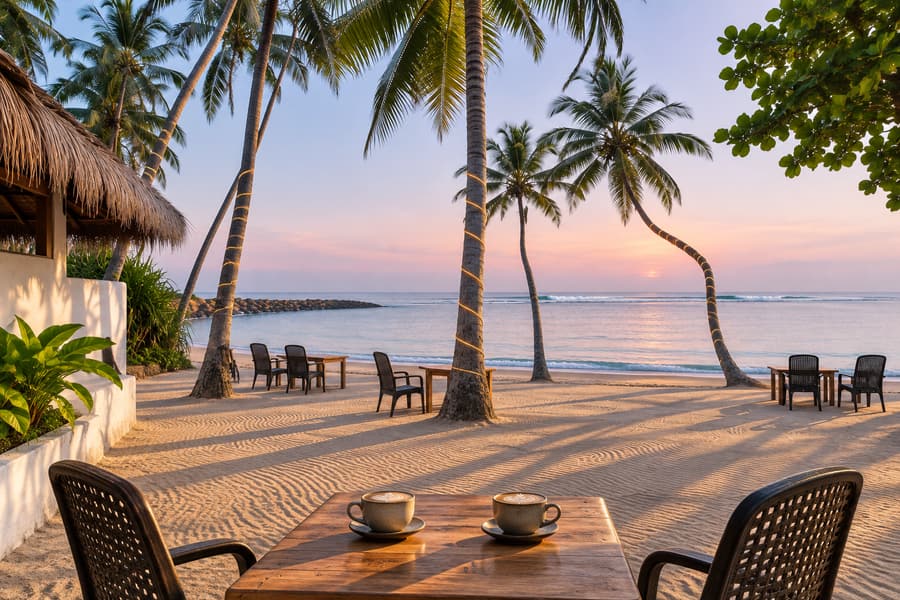
Dinner can be early. The sun sets at about six, the kitchen serves until 21:00, and a table at half past five has the light and the cool of the day together.
What is a day at Ohana like for you?
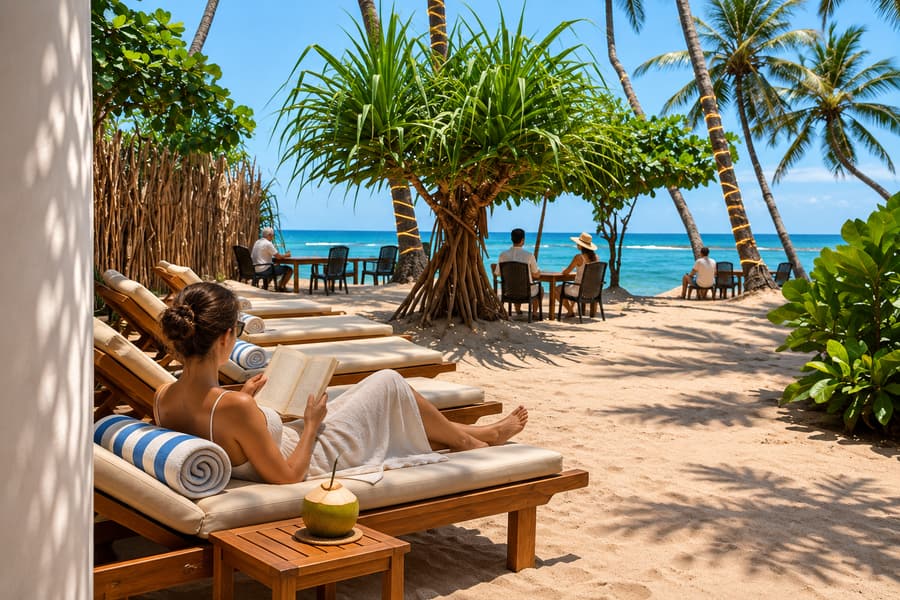
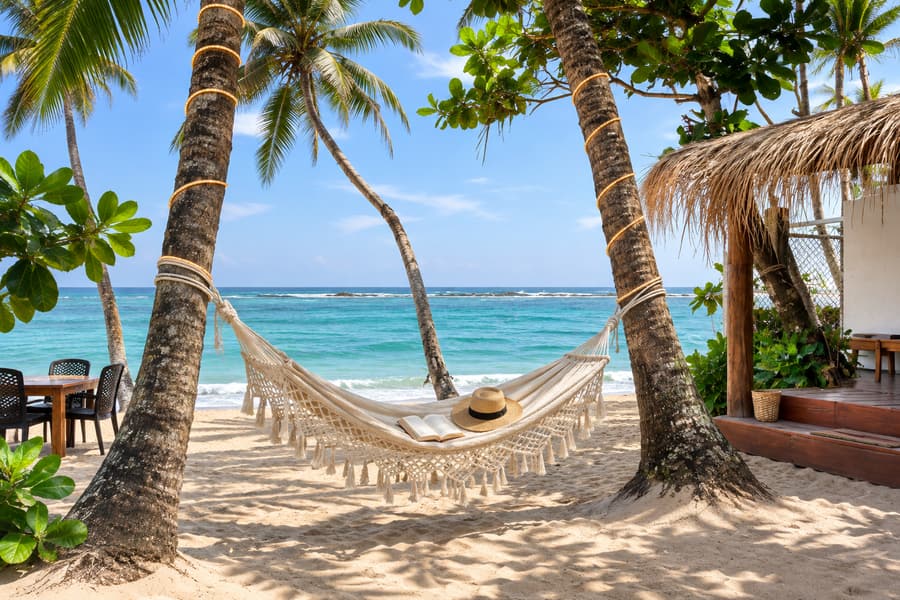
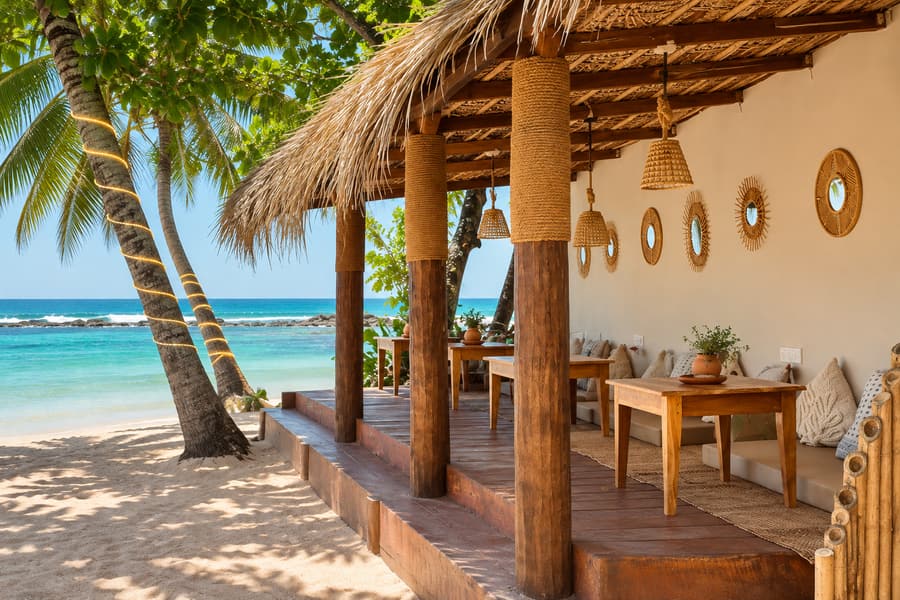
You sit under the palms, in a cabana or in the lounge. There is an upstairs terrace too. A sunbed is free for the whole day, one for each person, with 10,000 LKR a person spent on food and drinks, or 1,000 LKR an hour, towel included. Nobody will hurry you from a table.
You will also find children playing, because families are the heart of Ohana, and the five beach dogs who live here.
Our entrance is wheelchair accessible, with our car park in front of it, and the tables are a few steps away, on a gravel floor with a hard path: there is no soft sand on the way. We have chairs with arms and a firm back, and toilets are close by.
The garden is on the page of our beach club on a quiet beach in Dikwella. If you travel as three generations, see families.
What pace works?
One thing a day, and then the sea. A plan that is kind to the body:
- Before 10: the one outing, or a swim.
- 10 to 4: shade, lunch, a book, a sleep.
- After 4: a short walk on firm sand, and an early dinner.
Stay three or four nights in one place sooner than one night in four places. We wrote out such a day in a slow day in Dikwella, and the bag for it in what to pack for a beach day.
Good to know
- Ohana is at Turtle Beach, Dikwella, less than five minutes by road from Hiriketiya.
- Breakfast is served from 08:00 to 11:00, lunch and dinner from 11:00 to 21:00, every day.
- Food is not spicy unless the dish says so. No alcohol is served.
- Filtered water is on the house.
- Prices are in LKR, plus a 10% service charge.