The guide · Turtles and the bay · 5 min read
Reef friendly sunscreen explained, what the evidence says
What scientists know and do not know about sunscreen and coral reefs, which ingredients to look for, and why shade and clothing are the first choice.

"Reef friendly" on a sunscreen bottle is not a regulated term, so the words on the front tell you little. What helps a reef most is less cream in the water: shade and clothing first, then a mineral sunscreen on the skin that is left.
What does the evidence say?
It says something, but less than the labels suggest.
In laboratory studies, some of the chemicals that filter sunlight in ordinary sunscreens have harmed sea life. The United States ocean agency, NOAA, lists what such studies found: bleaching, damage and death in young corals, harm to the growth of green algae, defects in young mussels and sea urchins, and effects on fish. The same chemicals have been measured in the water at busy swimming beaches.
What is not yet known is how much of this happens in the open sea, where the cream is thinned by a great deal of moving water. Some scientists say the laboratory tests used conditions far from a real reef.
In 2022 the United States National Academies of Sciences reviewed the whole subject. Its report did not declare any sunscreen harmless, and it did not declare any a reef killer. It said the question is open and urgent, and asked the environment agency to carry out a full risk study, starting with places that see many swimmers. NOAA says the same in fewer words: more research is needed. You can read NOAA's page on sunscreen and corals.
One thing scientists do agree on: the great danger to coral reefs is the warming of the sea. Sunscreen is a small, local pressure beside it. But a small, local pressure matters in a small, shallow bay with many swimmers and little water moving through. That is exactly the kind of bay where people go to see turtles.
Which ingredients are in question?
NOAA's list of chemicals that can harm marine life includes:
- oxybenzone (also written benzophenone-3)
- octinoxate
- octocrylene
- benzophenone-1 and benzophenone-8
- 4-methylbenzylidene camphor and 3-benzylidene camphor
- OD-PABA
- nano-sized titanium dioxide and nano-sized zinc oxide
Some governments have acted before the science is finished. Hawaii has banned the sale of sunscreens with oxybenzone and octinoxate since 2021. Palau has banned ten ingredients since 2020. Most countries have no such rule, so in most places the choice is yours.
What should you look for on the bottle?
Turn it around. The list of ingredients is the only part worth reading.
- Mineral filters. Zinc oxide or titanium dioxide, as the only active ingredients. NOAA calls mineral sunscreen the better option.
- "Non-nano". The very small, nano-sized forms of the same minerals are on NOAA's list, so choose a cream that says its particles are not nano.
- None of the names in the list above.
- Protection that is enough for you. A cream that is kind to the reef and leaves you burnt has not done its job.
Mineral creams are thicker and leave a pale film on the skin. That is how they work: they sit on the skin. Rub in a little at a time.
A bottle with a turtle or a coral printed on it has proved nothing. Brands began to print "reef friendly" when the first bans arrived, and no authority checks the claim.
Why are shade and clothing the first choice?
Because a shirt never washes off. NOAA's own advice puts it in this order: look for shade in the middle of the day, wear clothing made to block the sun, and choose your sunscreen with care.
- A long-sleeved swim shirt. A snorkeller floats face down with the back to the sky. A shirt covers the back, the shoulders and the arms, which is most of the skin the sun reaches.
- Swim leggings or long shorts for children, and for the backs of adult legs.
- A hat and a shirt on land.
- Shade in the middle of the day. NOAA suggests looking for shade between 10 in the morning and 2 in the afternoon. Swim early, and have a long lunch in the shade.
With all that, sunscreen is only needed for the face, the neck, the hands and the feet. A small amount of cream on a small area is the kindest thing you can do for the water, whatever the label says.
Should you skip sunscreen for the reef?
No. The same National Academies report is clear that regular use of sunscreen lowers the risk of sunburn and of skin cancer. The tropical sun on this coast is strong all year, and the breeze off the sea hides it. Nobody helps a reef by burning.
This is general information and not medical advice. If you have sensitive skin, an allergy, or a child under care for a skin condition, ask your doctor or pharmacist which product suits you.
How do we see it at Ohana?
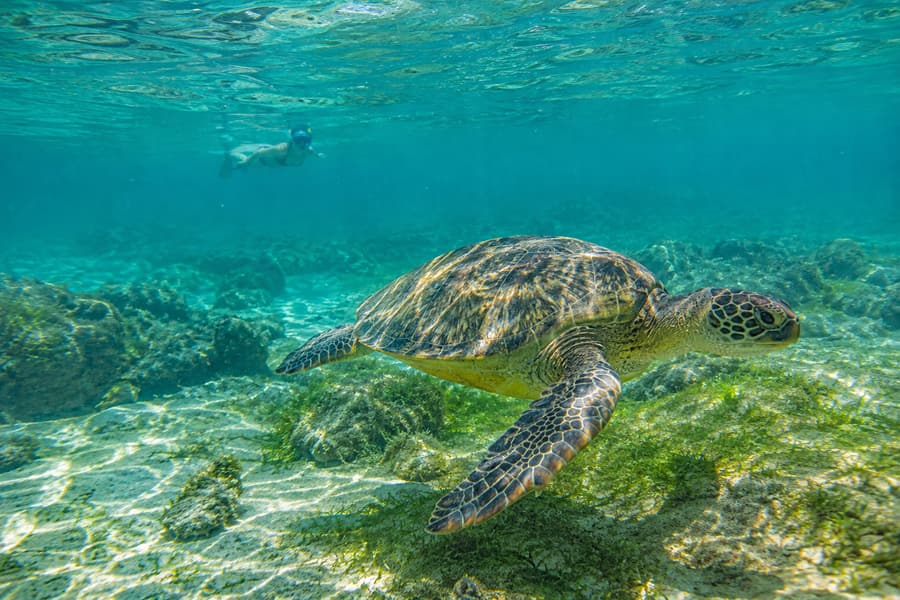
Our bay is small and calm, with a reef on the horizon where wild sea turtles often feed. What goes into the water here stays a while. So we ask guests for the simple things: cover up when you snorkel, use mineral cream on what is left, and never stand on the reef.
Shade is easy to find. There are palms, cabanas and a lounge, and lunch is served from 11:00. If yours is the wrong kind or still at the hotel, we have mineral sunscreen, and it is also for sale. We have no swim shirts, so bring your own.
If you are getting ready for the water, read how to snorkel with turtles respectfully and our list of places for snorkeling near Hiriketiya and Dikwella. There is more about the bay on our page about Turtle Beach and swimming with turtles.
Good to know
- Ohana is at Turtle Beach, Dikwella, less than five minutes by road from Hiriketiya.
- Snorkel masks are lent free. Ask at the bar.
- Sunbeds, hammocks and cabanas are in the garden. Sunbeds are free for the whole day, one for each person, when each person spends 10,000 LKR on food and drinks; otherwise they cost 1,000 LKR an hour each. A towel comes with every sunbed.
- Filtered water is on the house.
- Lunch and dinner are served from 11:00 to 21:00, every day.